Backgammon Rules
Complete illustrated guide — everything you need to know to play
What is the objective of backgammon?
Backgammon is a race game with checkers and dice for two players. Each player starts with fifteen checkers of their color, two dice, a dice cup, and a special cube used to raise the stakes: the doubling cube. Players move their checkers across the board according to dice rolls.
To win the game, a player must first bring all their checkers into their home board, then bear them off the board. A player's "home" is called a board, or inner board. In Backgammon, checkers are commonly referred to as men. It is therefore a race game along a track.
How to set up a backgammon board?
Here is the board from the mirrored perspective of both players in the starting position:
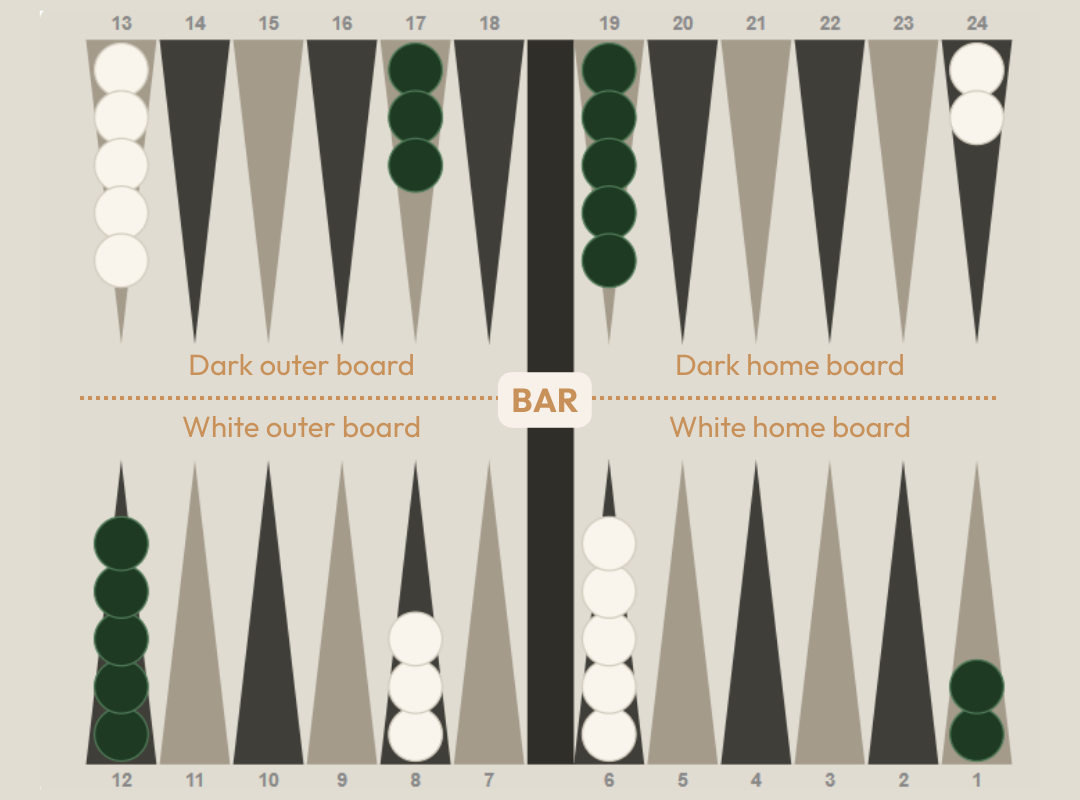
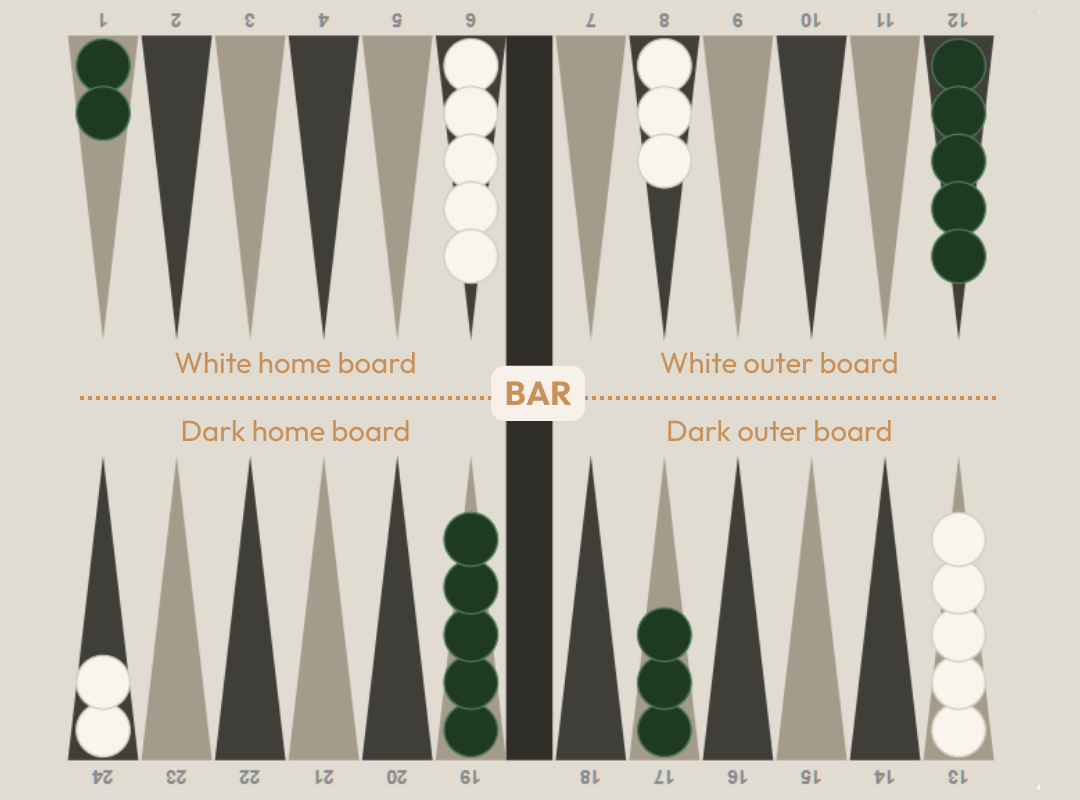
It has 24 triangles called interchangeably points or spaces. Six adjacent points form a board. The four boards have specific names:
- White's inner board
- White's outer board
- Black's outer board
- Black's inner board
The separation between inner and outer boards is marked by the bar, which plays an active role in the game of Backgammon.
On Backgammon Circle, the default position is the first one, so your inner board is at the bottom right. You can change this in the settings. Since a good Backgammon player should be comfortable playing in both directions, we even offer the option to automatically switch sides after each game.
How to start a backgammon game?
To begin, both players simultaneously roll a single die each on a different half of the board. The player with the higher die plays first, combining their own roll with their opponent's die. Ties are re-rolled.
For all subsequent moves in the game, players alternate rolling two dice.
How do you move checkers in backgammon?
The board can be visualized as a U-shaped track. A checker, or man, regardless of its position on the board, moves along this U-shaped track, always forward.
The movement of checkers is illustrated in the image below:
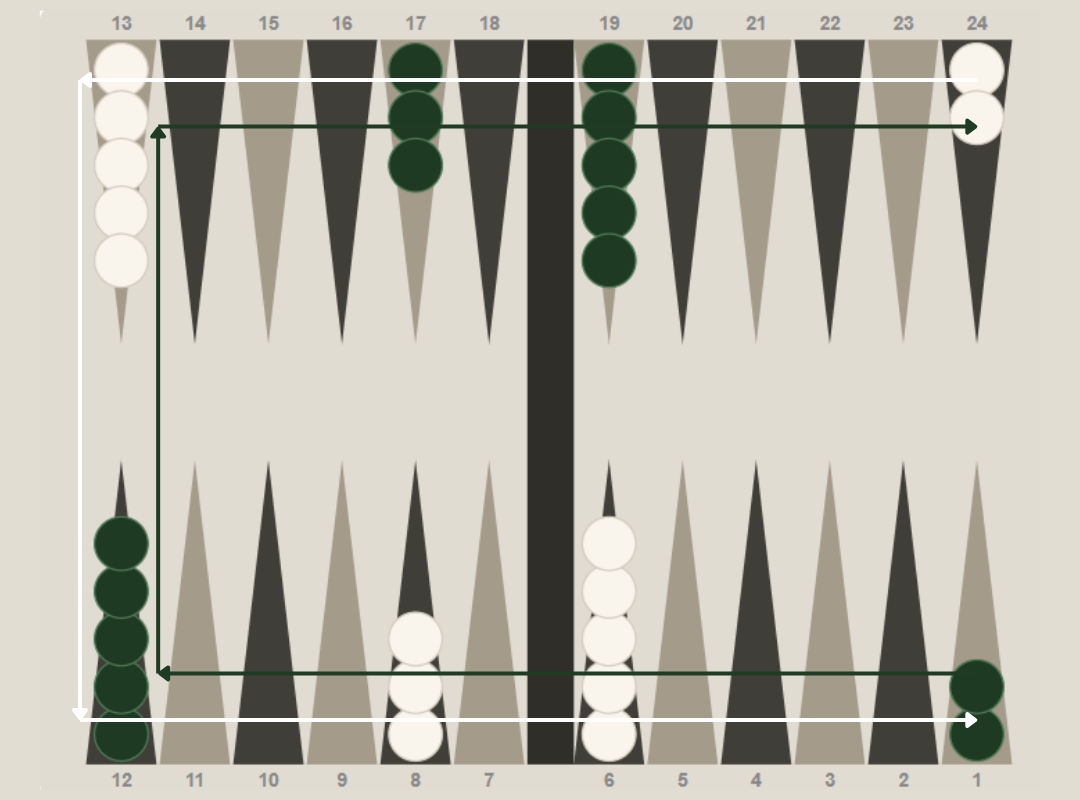
The black checkers advance from White's inner board, cross the bar, pass through White's outer board, round the hinge (the U), enter Black's outer board and finish their race in Black's inner board.
In other words, Black advances from point 1 toward point 24 and vice versa.
The bar is not a space in itself; crossing it costs no movement points.
The roll of two dice determines the number of spaces checkers can move forward. The respective values of the dice are not added together and are treated as independent moves, although they may be combined on the same checker.
For example, a roll of 2 and 4 does not represent a move of 6 spaces but rather a move of 2 spaces and a move of 4 spaces. There are three ways to play this roll:
- Move one checker 2 spaces, then another checker 4 spaces.
- Move the same checker 2 spaces then 4 spaces.
- Move the same checker 4 spaces then 2 spaces.
For a roll of 5-3 for example, here is a possible move applying both moves to the same man:
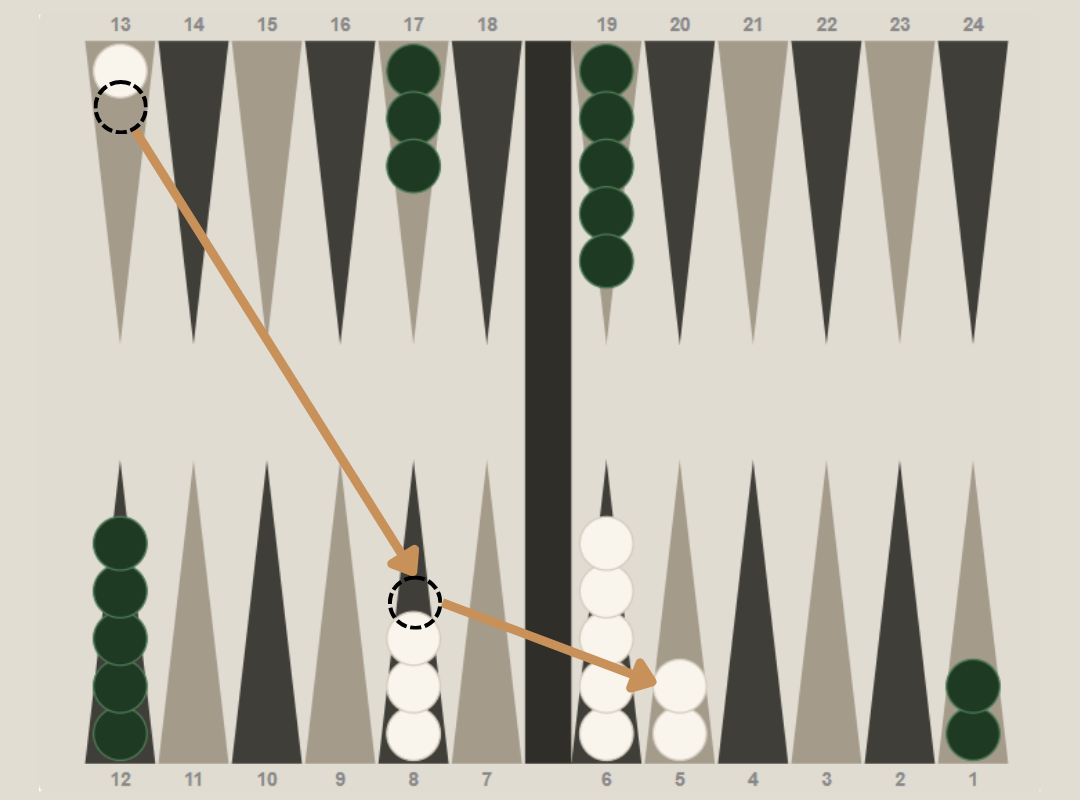
When doubles are rolled (1-1, 2-2, 3-3, 4-4, 5-5, 6-6), each die counts for two moves. There will therefore be 4 moves. A roll of 6-6 for example allows 4 moves of 6 spaces, which can be distributed as follows:
- Move one checker 6 spaces 4 times.
- Move one checker 6 spaces 3 times and another checker 6 spaces once.
- Move one checker 6 spaces twice and another checker 6 spaces twice.
- Move one checker 6 spaces once and another checker 6 spaces 3 times.
- Move 4 different checkers 6 spaces each.
What are the legal moves in backgammon?
A checker may land on any empty space. It may also land on a space occupied by one or more of its own checkers. There is no limit to the number of same-colored checkers stacked on a space. Finally, a checker may land on a space occupied by one and only one opponent checker.
A move cannot end on a space occupied by at least two opponent checkers. It is even impossible to stop "in passing" on such a space when combining the values of two dice. However, it is possible to pass directly over a space occupied by several opponent checkers.
For example, in the following situation if the black player rolls 5-4, they can neither advance their back checkers by 4 or 5, nor move them directly by 9 (even though the corresponding space is available).
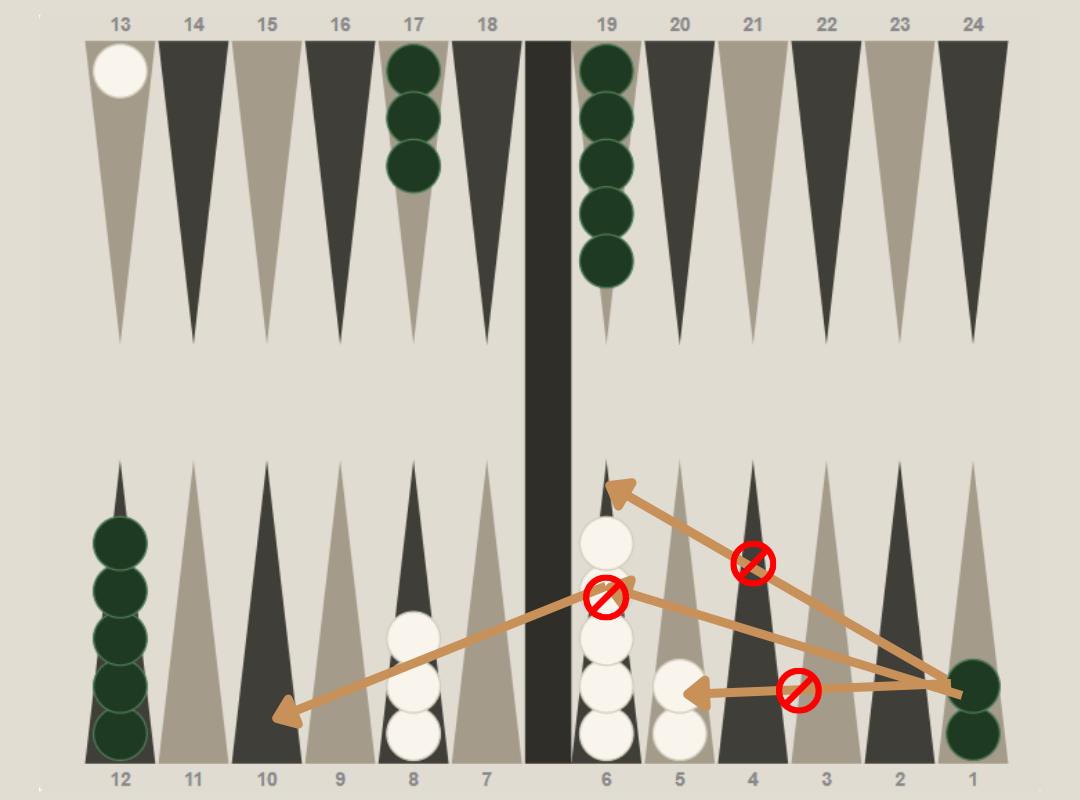
It is forbidden to pass your turn as long as a move is possible. Both dice must be played if legal moves exist. Furthermore, if there is at least one way to play both dice, it is forbidden to play one die in such a way that no legal move remains for the other die. If it is not possible to make both moves, the higher die must be prioritized when possible.
Unplayed dice are forfeited.
How does hitting and entering work?
Two or more checkers occupying a point control that point. A single checker on a point is called a blot. When a move lands on an opponent's blot, that checker is hit and placed on the bar. The hit checker is temporarily out of play. However, hitting is never mandatory.
A player with one or more checkers on the bar must re-enter them before making any other move on the board. Re-entering is done in the opponent's home board. To do so, you use a die whose value lands on an open point in the opponent's home board.
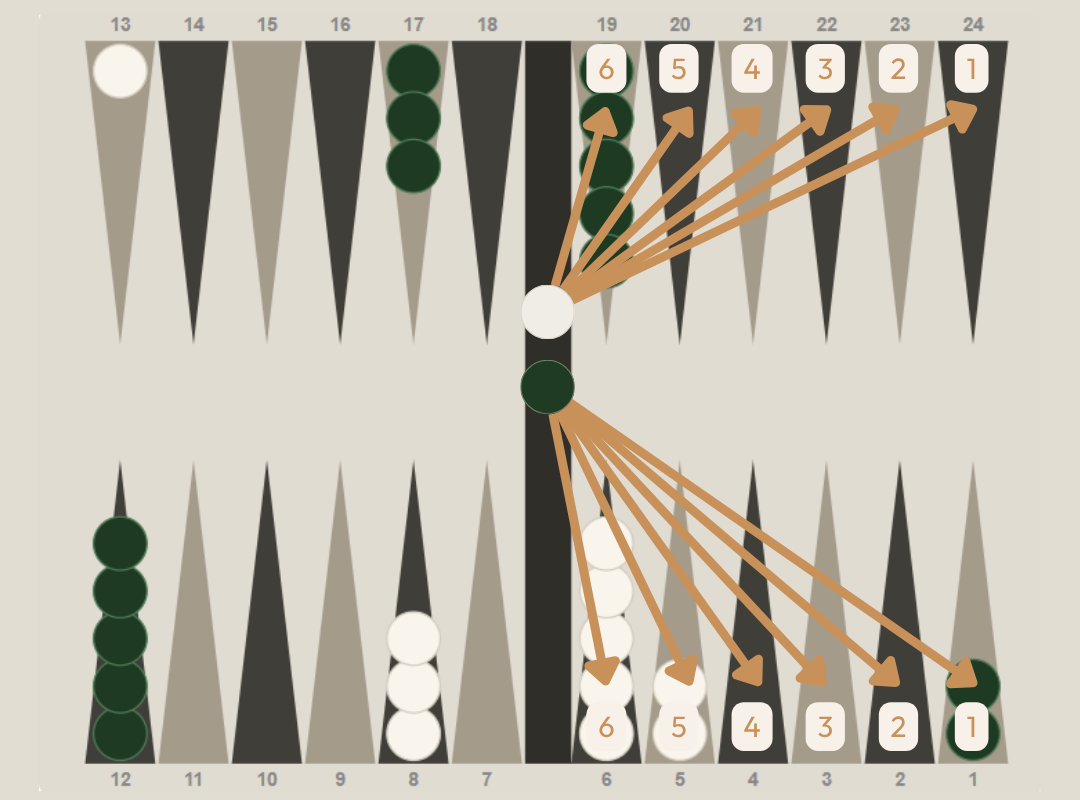
If Black has a one among the two dice, they can re-enter on the first point of White's home board, provided that point is empty, occupied by Black's own checkers, or occupied by a single opponent checker.
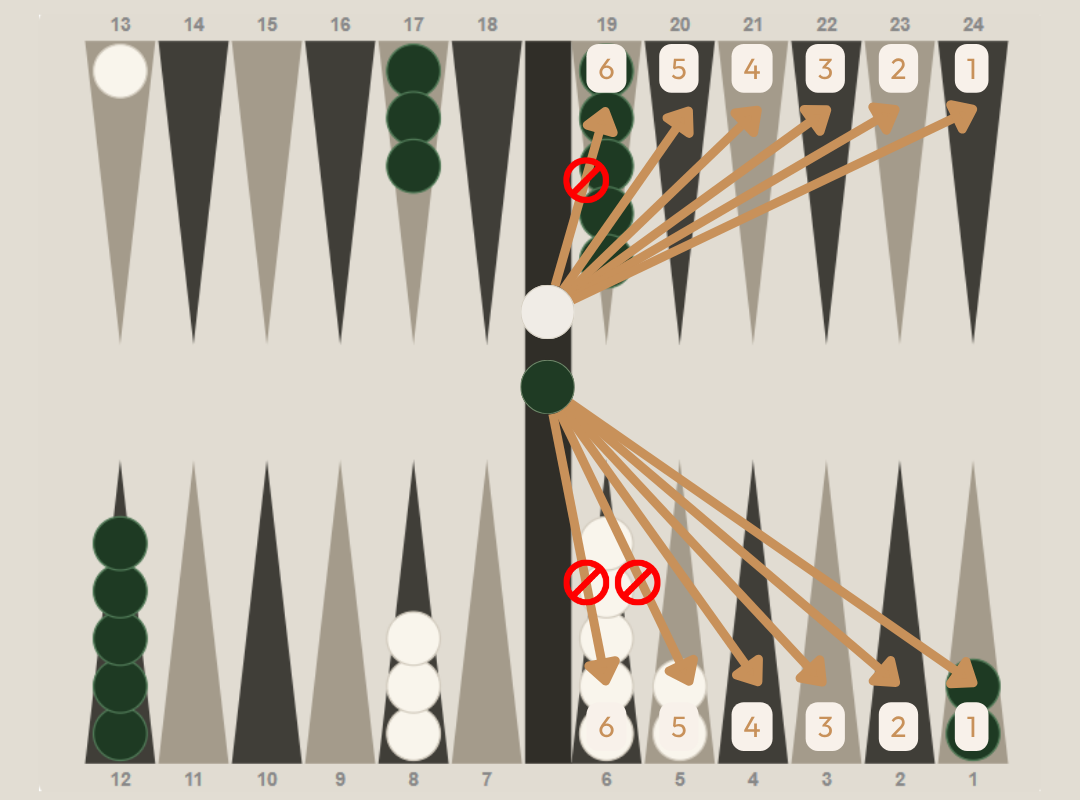
The value needed to re-enter on an open point must come from at least one of the two dice — combining the values of both dice to re-enter is not allowed.
Points occupied by two or more checkers (necessarily of the same color) form blocked points on which opponent checkers cannot land. With a checker on the bar, if both dice land on blocked points, re-entering is impossible for that turn. The player passes and must wait for the next turn to try again. Since they cannot move any checkers already on the board until they have re-entered, their opponent immediately takes control.
When a home board has a blocked point on each of its 6 points, it is said to be closed. An opponent with a checker on the bar cannot play until at least one point is opened up.
How to bear off in backgammon?
The intermediate goal of a Backgammon game: bring all your checkers into your home board. This is the bear in phase.
You can then start bearing them off, known as the bear off phase.
Once a checker is borne off, it stays off for the rest of the game. If one of your checkers is hit after you've started bearing off, you cannot bear off any more checkers until the hit checker re-enters and travels all the way back to your home board.
The first player to bear off all fifteen checkers wins the game.
Bearing off means moving a checker beyond point 1 of your home board. For example, if White rolls 6-4 when all points in their home board contain at least two checkers, they MUST use the 6 to bear off a checker from point 6. The 4 CAN be used to bear off from point 4, but it can also be used to move a checker 4 points forward, from point 5 or 6 to point 1 or 2 respectively.
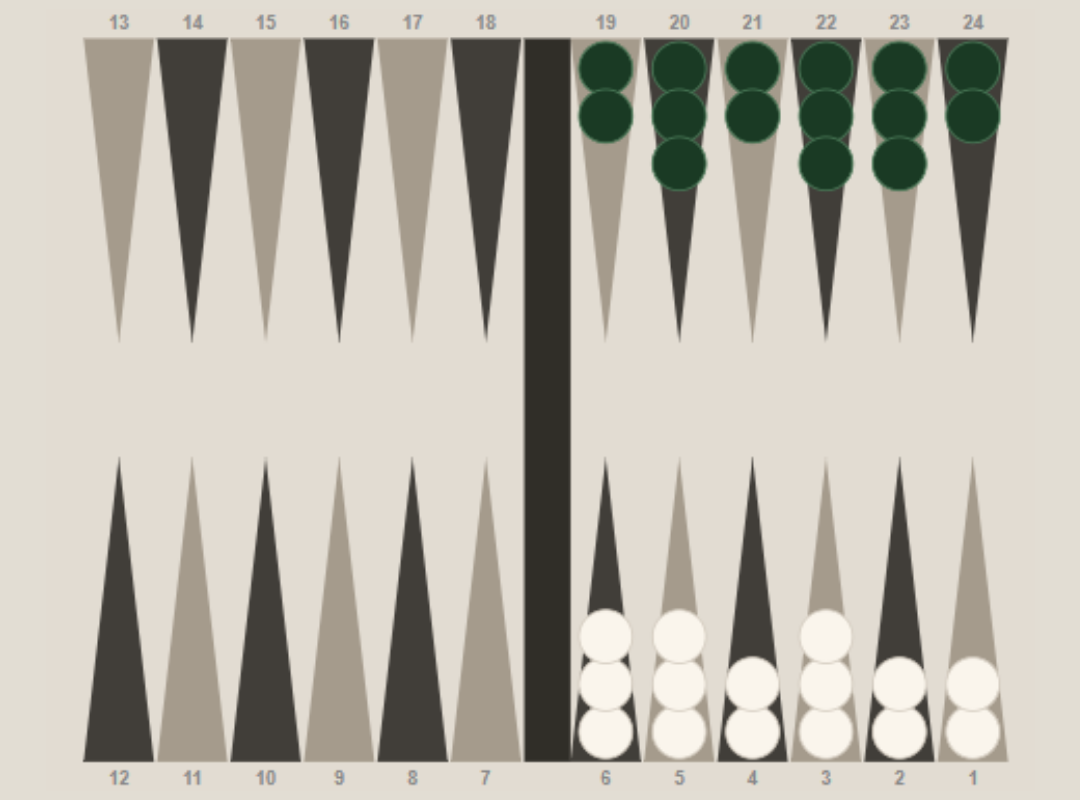
If a die shows a value strictly higher than the highest occupied point, you must bear off a checker from the highest occupied point.
Whenever possible, a die must be played to its full value.
How does the doubling cube and scoring work?
The initial stake of a game is one point. This point is won by the first player to bear off all their checkers. But the stake can increase during the game. It is represented by the face value of the doubling cube, numbered 2, 4, 8, 16, 32, 64.
At the start of a game, the doubling cube is placed between both players showing the face value 64. There is no 1 on the cube — the value 64 represents the default initial stake of 1 point at the beginning of a game.
A player can propose to double the game's stake, especially if they feel they have gained a significant advantage. To do so, they offer the cube on the 2 face to their opponent, and this must be done before rolling the dice.
Note: a player who is blocked from moving can still propose to double.
When offered a double, a player can take one of two approaches:
- Pass: refuse the double, immediately conceding the game to the opponent for one point.
- Accept the double (take): they physically take possession of the cube and continue the game with doubled stakes. By accepting the cube, the player becomes its owner. Only they now have the right to re-double.
The game's stake can be doubled and re-doubled multiple times, subject to the following restrictions:
- At the start, the cube is in the center and either player can double. Subsequently, only the player who owns the cube can double.
- A player can double just before their dice roll. If the double is accepted by the opponent, the player rolls and makes their moves. Otherwise, they immediately win the stake at the cube value before the double proposal and the game ends.
The winner of the game scores the number of points shown on the cube, except in the case of a gammon or backgammon.
- Gammon: a gammon occurs when a player has borne off all their checkers while their opponent has not borne off any. The gammon winner scores double the face value of the cube.
- Backgammon: a backgammon is an extension of the gammon in which the player who has not started bearing off still has at least one checker in the opponent's home board. The winner then scores triple the face value of the cube.
Note: in some countries, a backgammon is worth only double rather than triple.
Backgammon is generally played as a match to X points, with the first player to reach or exceed the set number of points winning the match. A Backgammon match always uses an odd number of points, typically 3, 5, 7, 9, 11, or 13.
Important match play rule: the Crawford rule states that if one player reaches a score of exactly 1 point less than the match target, the doubling cube is removed from play for the following game (doubling is not allowed). This applies for one game only — if the match continues, the cube returns.
What are the backgammon variants?
Here are some options players can agree on at the start of a free play game:
- Automatic double: when the very first dice roll produces doubles, the cube stays in the center but its value automatically goes to 2 (instead of 1). By convention, only one automatic double per game is allowed. The dice are re-rolled to determine the first move.
- Jacoby rule: if the cube has not been doubled during the game, gammons and backgammons are worth only one point.
In match play, where you need to reach a set number of points to win, automatic doubles and the Jacoby rule generally do not apply. These are essentially free play or money game rules.
The Chouette
The chouette is a special variant that brings together 3 or more players in a single game. All players roll one die each, and the highest roller becomes the player "in the box." This player plays the game alone, while all the other players team up against them.
The second-highest roller becomes the captain. The captain alone moves the team's checkers against the player in the box. The team may however consult before any decision. In case of disagreement, the captain's choice prevails. The relative ranking of the initial roll also determines the order in which the team players take their place alongside the captain.
If the team loses the first game, the second player becomes the new captain. The deposed captain moves to the last position in the team. Thanks to the victory, the player in the box stays in the box. Conversely, if the team wins the game, the captain moves into the box, is replaced by the second player, while the player who was in the box takes the last position in the team.
The decision to propose a double to the player in the box must always be unanimous within the team. However, if the player in the box proposes a double, each team member may individually decide whether to accept or refuse the cube. Players who refuse concede the current stake to the player in the box and drop out of the current game. Players who accept the cube continue as a team for the new stake. If they win, the player in the box pays each winner the game's stake. If they lose, each of them pays the stake to the player in the box.
Conventions and Etiquette
These are the standard conventions and etiquette observed in competitive and social backgammon:
- Players roll the dice in the right half of the board and always use a dice cup.
- A roll is not valid and must be replayed in the following cases:
- Both dice did not land in the right half of the board.
- A die is cocked (not lying flat).
- A die lands on top of a checker.
- A player's move is considered final when they pick up their dice, not when they have completed all their moves. In particular, a move can be changed as long as the dice have not been picked up.
- A dice roll made before the opponent has picked up their own dice is not valid. There is an exception to this rule when both players are bearing off after breaking contact, or when a move is entirely forced.
- An illegal move can be called by any player, but must be pointed out before the next roll. Errors, even obvious ones, that are not flagged in time stand as played.