πŸ€–
James_BG
Elo 1850
πŸ€–
Emily_42
Elo 1720
Live game between bots β€” Your future opponents are warming up

BackgammonCIRCLE

Join the circle

The world's oldest game, reinvented.
Play backgammon online.
Play. Improve. Compete.

In active development β€” Be among the first 200 members of our community

The Home of Backgammon
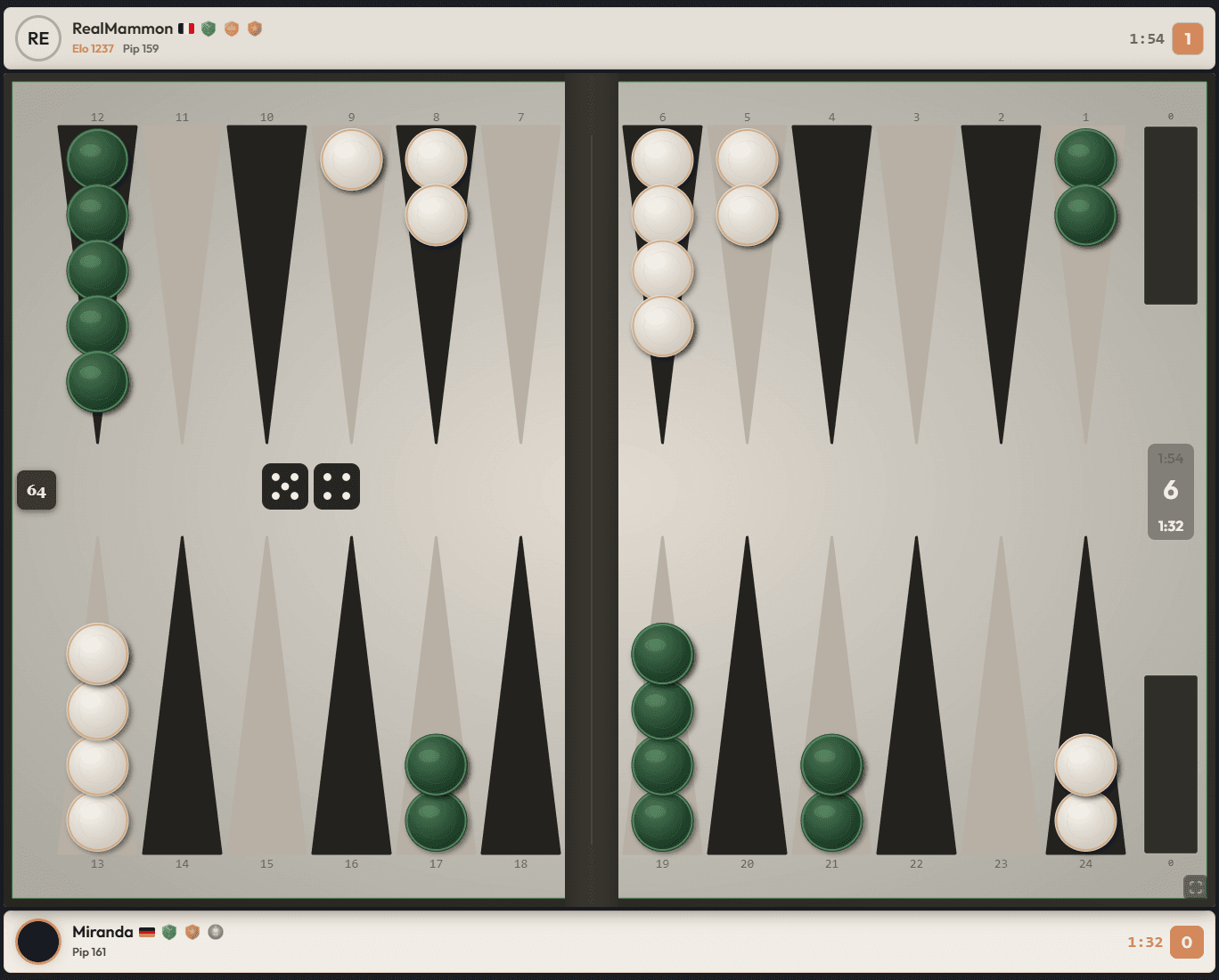
Play online

Play online

Challenge players from around the world in real time. Elo rating, live and correspondence games.

Level up with our interactive professor

Level up with our interactive professorSoon

Learn with quick, fun lessons designed for players of all levels.

Analyze your games

Analyze your games

GNU Backgammon move-by-move analysis, advanced statistics and progress tracking.
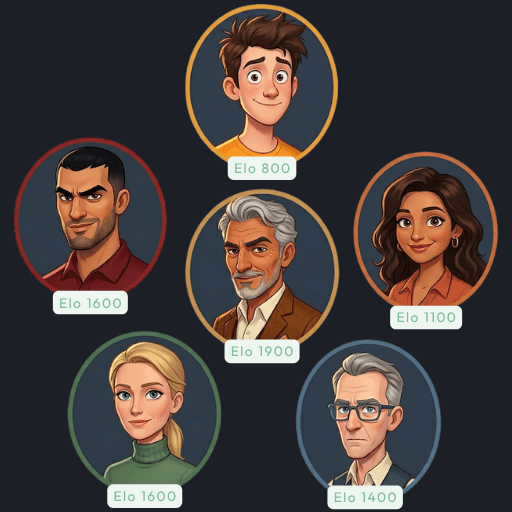
Challenge our bots

Challenge our bots

Bots of all levels with unique personalities to practice anytime.

Customize your experience

Choose from multiple board themes, pick your preferred move direction, switch between dark and light mode, and configure how you move your checkers.

Join a community of enthusiasts

Clubs, blogs, backgammon news and discussion spaces between players.

Join eventsSoon

Tournaments, weekly challenges and player-vs-player contests.

What is Backgammon?

Born over 5,000 years ago in Mesopotamia, backgammon is the oldest board game still played today. A captivating duel where strategy, probability and intuition collide with every roll of the dice, played by millions of enthusiasts across the globe.

Yet despite its richness and worldwide popularity, backgammon never had the online platform it deserves. That's why we created Backgammon Circle: Backgammon as it deserves to be played.

The origin of the word "backgammon" is debated among historians. The most widely accepted theory traces it to Middle English: "back" (return) and "gamen" (game), evoking the idea of a game where captured pieces must return to the board. Other scholars see a Welsh root, "bach" (small) and "cammon" (battle), meaning "little battle." The game itself is far older than its English name. It descends from the Egyptian Senet and the Royal Game of Ur, dating back over 5,000 years. Over the centuries, it has been known by many names across cultures: Tabula among the Romans, Nard in Persia, Tavla in Turkey, Trictrac in France. Whatever the true etymology, backgammon carries in its name the very essence of its mechanics: a constant back and forth between attack and defense, between advance and retreat.
Backgammon is played by two players on a board with 24 points, each starting with 15 checkers. On each turn, you roll two dice and move your checkers accordingly. The goal is to race around the board and bear off all your checkers before your opponent. You can hit your opponent's exposed checkers, block their moves by building "primes" and use the doubling cube to raise the stakes. The rules can be learned in minutes, but mastery takes years. Read the full rules β†’
Backgammon is above all a major intellectual and strategic game. Among all board games, it offers the finest balance between skill and probability, making it a uniquely compelling challenge. The dice introduce uncertainty on every turn, but it is precisely how you exploit each roll that separates the novice from the expert. Top players master the concepts of racing, timing, positional structure and risk management. They know when to build a defensive wall, when to hit an exposed blot and when to offer the doubling cube at the moment of maximum advantage. Over hundreds of games, an expert player dominates a casual player overwhelmingly, far more than in any other game involving dice. It is therefore a true strategic battle on the board where positional and tactical aspects require the use of probability, logical thinking, imagination, intuition and sometimes psychology to control the opponent's game. This is why an expert player who develops ingenuity and experience will master randomness in a way that allows them to win most often.
A single game takes 5 to 15 minutes, perfect for a break. In competitive matches with multiple rounds and the doubling cube, expect 20 to 45 minutes depending on the match length. Thrill seekers can try speedgammon with a tight 30 second timer per turn. On Backgammon Circle, you choose your pace: Relaxed, Standard, or Speedgammon, live or turn by turn.
Logical thinking is at the heart of the game. The best players master statistics and probability, mentally calculating the odds of every outcome to make the optimal decision on each move. They possess exceptional analytical and reflective abilities, a capacity for spatial visualization of the board, speed of thought and above all a talent for anticipation and projection that allows them to weigh the pros and cons of each move or cube decision several turns in advance. Theoretical study of the game is also essential: knowledge of openings, mastery of race evaluation (pip count) and a deep understanding of match play strategy (score management, Crawford rule) set accomplished players apart. Finally, concentration, composure, patience and clear headedness are indispensable qualities. Backgammon is a mental sport where consistency over time matters as much as occasional brilliance. The greatest champions are those who maintain their optimal level of play even under the pressure of decisive moments.
18,528,584,051,601,162,496 to be precise. That's roughly 10¹⁸ ways to arrange the 30 checkers from both players on the board, whether on any of the 24 points, on the bar, or borne off. Every game is unique, and that is what makes backgammon inexhaustible.

Ready to join the circle?

Start for free.
No registration required.